Do Good Institute Report Finds Successes in State’s Service-Workforce Development Programs
By Saher Randhawa
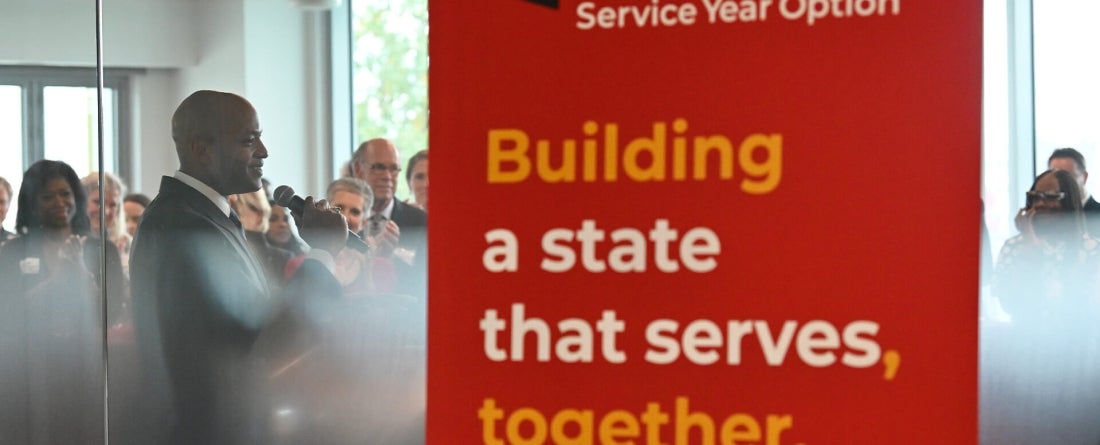
When Governor Wes Moore took office, he championed a vision to make Maryland “The State that Serves.” That vision became a reality with the creation of the Department of Service and Civic Innovation (DSCI) and its flagship programs: the Maryland Corps/Service Year Option (MC/SYO). Now, thanks to a new partnership with the University of Maryland’s Do Good Institute, we have a comprehensive look at the early impact of these groundbreaking initiatives.
The Do Good Institute recently completed a process evaluation of the first two years of the MC/SYO programs, and the findings are clear: this is not just another government program. It represents a new wave of service and workforce development that is intentionally designed to prepare young Marylanders for meaningful careers while simultaneously meeting critical community needs.
The report, authored by researchers Nathan Dietz, Tommy Bennett, Grace Connors, Lynn Handy, and Julie Miller, examines the structure and processes of DSCI’s innovative model. The MC/SYO program connects members with Host Site Partners (HSPs) across the state, where they work full-time for nine months, earning a living wage and accessing professional development, mentoring, and even apprenticeship opportunities. The goal is ambitious: to create a talent pipeline for Maryland that benefits both the individual and the community.
What makes this evaluation so important is what it reveals about the evolution of service programs. Unlike traditional models that focus solely on volunteerism, the MC/SYO programs intentionally blend service with workforce development. Members are not just giving back; they are gaining hard skills, earning credentials, and developing professional networks. As the report’s conclusion notes, DSCI’s emphasis on service “opens the door to an even broader base of support for initiatives that will prove essential to long-term economic health.”
The evaluation highlights several key findings. The programs are already achieving impressive outcomes, with over 1,600 Members placed at over 200 Maryland organizations across three classes, including a 176% growth in class size from the inaugural class to third class. The partnership with technology provider BuildWithin has streamlined the matching process between applicants and Host Site Partners, using advanced technology to connect Members with the right Host Site Partners. And DSCI has embraced a “data-driven” culture from day one, using surveys and analytics to continuously improve the Member and HSP experience.
The report also identifies areas for growth. As the programs scale from hundreds to thousands of participants, challenges around transportation, communication with HSPs, and alumni engagement will need to be addressed. The Do Good Institute’s recommendations, ranging from creating regional onboarding sessions to developing an early warning system for at-risk HSPs, provide a roadmap for DSCI to navigate this expansion.
Perhaps most importantly, this evaluation underscores that the MC/SYO programs are more than a policy initiative. They are a lifeline for young adults seeking direction and a talent solution for organizations across the state. The report showcases powerful examples of HSPs like the Maryland State Police and the Boys & Girls Club, which have used the program to build capacity and develop their future workforce. As one HSP noted, the intentional design of the program is apparent and impacts how they navigate their partnership with DSCI.
For organizations in Maryland, the message is clear: this is an opportunity to invest in the next generation while strengthening your own workforce. The demand for placements is growing, and the need for committed Host Site Partners has never been greater. Whether you are a nonprofit, a government agency, or a business, you have a role to play in making Maryland the State that Serves.
Become a Host Site Partner. Help shape the future of Maryland’s workforce, one Member at a time. To learn more or to apply, visit DSCI’s website today.