By Saher Randhawa
A discharged patient goes home with two days’ worth of balanced, nutritious meals. A middle school student does her first genetic experiment and decides she might like science after all. A student-led conference creating space for conversations about medical discrimination: these moments reflect how students are turning ideas into meaningful impact through the Do Good Campus Fund.
Through the Do Good Campus Fund, 16 ILS Honors students received up to $500 in funding and mentorship to support students in translating their ideas into community service and social impact. The range of projects reflects both the breadth of their interests and a shared commitment to bridge gaps in their local communities. Within the Integrated Life Sciences (ILS) Honors program, this mission is brought into the classroom through the required first-year service-learning course. Early meetings focused on project presentations, peer feedback and refining goals. Students learned communication and marketing strategies to connect with partners and developed outreach materials. They also created a final video reflection to present their work.
Many projects focused on health access, literacy and education.
- Recovery Recipes, led by Jessica Bui, Mercy Kassim, and Dipti Kafle, provided discharged patients with balanced, nonperishable meal packages tailored to dietary needs. The team partnered with the Howard County Medical Center’s Population Health Department, specifically the Community Care Team, and worked with organizations such as Terps Against Hunger, Hunger-Free Workgroup, and the Campus Pantry.
- Anaphylaxis Education, led by Lilyanna Bergfalk and Sahasra Lella, raised awareness about anaphylaxis, common allergens, and proper EPI-PEN usage through infographics and workshops on campus.
- Oral Health Literacy, led by Kenneth Aniya and Alexander Aniya, addressed the link between oral hygiene and Hospital-Acquired Pneumonia (HAP) by creating accessible oral hygiene kits and educational materials for patients with disabilities and their caregivers.
Students also introduced younger learners to science and healthcare careers.
- Gateway to Genetics, led by Katelyn Santos, Caroline Santos, Kirn Khan, and Victoria Selden-Angel, offered interactive workshops for middle school students to build foundational knowledge in genetics.
- The Medical Explorers Club, led by Lena Givens, worked to establish an ongoing partnership with Northwestern High School through guest speakers, first aid clinics, and field trips to healthcare facilities.
Advocacy and storytelling were central to another group of projects.
- STring Of Remembrance and You (STORY), led by Reem Ayache, connected students with elderly residents through recorded interviews that shared advice, personal stories and reflections. These recordings are made accessible through QR codes placed on flyers.
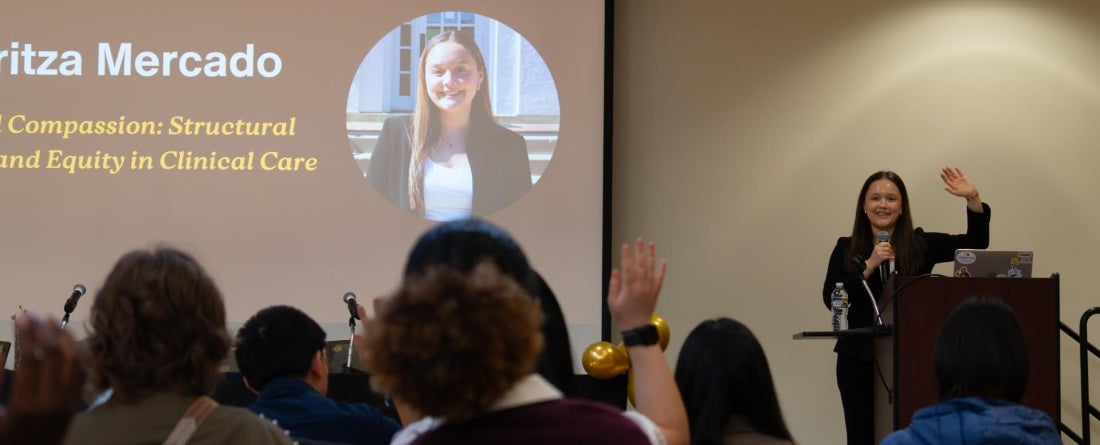
- More Than a Patient, a conference about medical discrimination, led by Joanna Chang, brought together students, healthcare professionals and advocacy groups on campus to discuss medical discrimination and share lived experiences.
Students reflected on their experiences and what they learned. “The most rewarding part of this project was being able to see our idea turn into a reality and see the impact we made,” said Caroline Santos of Gateway to Genetics. “Being able to see the students learn, grow and gain confidence in science made the project very worthwhile to me and excites me to engage in projects like this in the future.”
For Alexander Aniya and Kenneth Aniya of Oral Health Literacy, the institutional support mattered as much as funding: “The backing of the institution provided invaluable credibility and visibility, allowing us to advocate for oral health access for individuals with disabilities, present our findings as panelists from interviews with dentists and caregivers, and begin building our work to potential IRB-approved research after distributing kits.”
ILS assistant director, Jalah Townsend, saw the bigger picture: “It has been especially rewarding to watch students move from an idea to an initiative that actually reaches people. That’s exactly what this fund is designed to make possible.”
By combining funding, mentorship and structured learning, the program enabled students to create projects that address community needs and build a foundation to Do Good.